
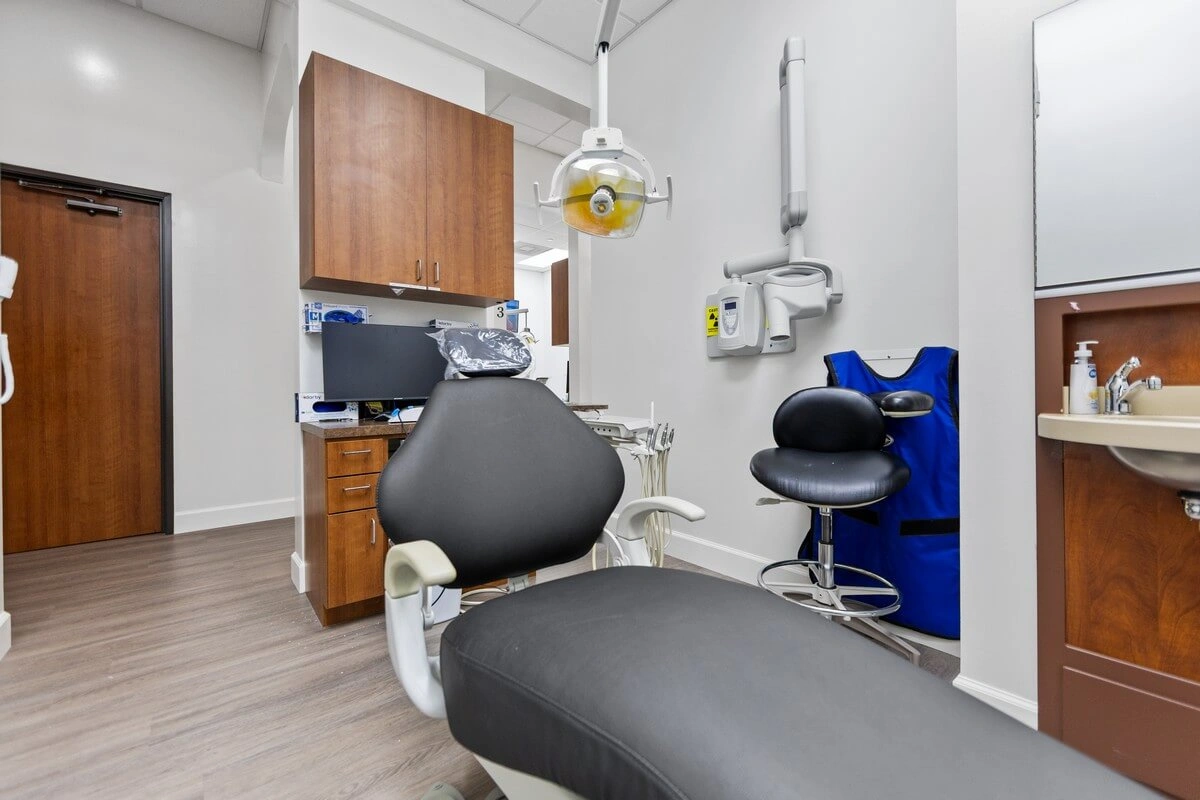
At a glance
An oral cancer screening is a short look-and-feel exam of your lips, mouth, tongue, throat, jaw and neck, done by the dentist at your regular checkup. It takes a few minutes, doesn’t hurt, and uses no special lights, dyes or devices.
If something looks suspicious, we don’t take the biopsy here; we refer you to a specialist for it. Saturday checkups are available.
| Item | Details |
|---|---|
| Visits | Part of your regular checkup; no separate appointment |
| Time | A few minutes |
| Numbing | Not needed |
| Method | Visual and hands-on exam by the dentist; no special lights, dyes or devices |
| If something is found | We monitor it or refer you to a specialist for a biopsy |
| Price | Part of your exam (see dental prices) |
| Saturday appointments | Yes, Saturdays 9am–3pm, plus Tuesday and Wednesday |
Do you need an oral cancer screening?
Every adult benefits from a check at their regular dental visits; it’s a core part of preventive dentistry. It matters even more if you have risk factors or notice a change. Call us sooner than your next checkup if you notice:
- A sore, ulcer or rough spot in your mouth or on your lip that hasn’t healed in two weeks
- A white or red patch inside your mouth
- A lump or thickening in your cheek, tongue or neck
- Numbness, pain or tenderness in the mouth or lips without a clear cause
- Trouble chewing, swallowing or moving your tongue or jaw
- Hoarseness or a feeling that something is stuck in your throat
Who is at higher risk?
Risk goes up with tobacco use of any kind, heavy alcohol use, certain types of HPV infection (linked to throat cancers), long sun exposure on the lips, and age, which is one reason screening is part of senior dental care. Oral cancer can also occur in people with none of these risks, which is why we check everyone.
What happens at your visit?
- We ask about any changes you’ve noticed and about risk factors such as tobacco and alcohol use.
- The dentist looks at your lips, gums, the inside of your cheeks, the roof and floor of your mouth, and the top, sides and underside of your tongue.
- The dentist gently feels your tongue, floor of the mouth, cheeks, jaw and the lymph nodes in your neck for lumps or firm areas.
- The back of the throat is checked as far as can be seen.
- We record anything unusual. Many spots are harmless, such as a bite injury or a sore from a denture that rubs, and we may re-check in about two weeks.
- If an area looks suspicious or doesn’t heal, we refer you to a specialist for a biopsy and further care.
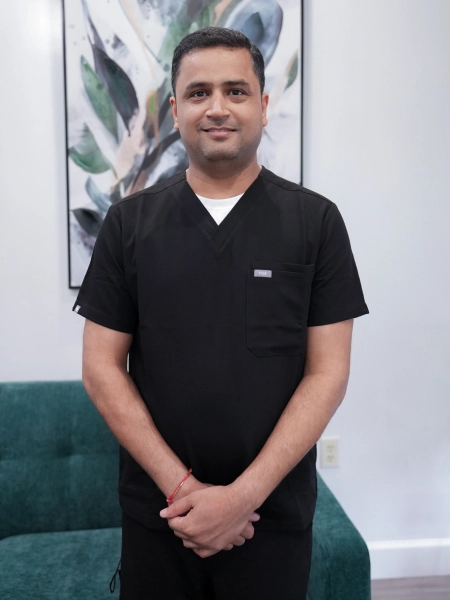
Our team includes Dr. Harsh Patel, whose training includes oral and maxillofacial pathology, the field that studies diseases of the mouth and jaws.
Cost, insurance and financing
The screening is part of your exam rather than a separate procedure, and we don’t use extra devices. New patients can start with our new-patient prices: $49 limited exam with panoramic X-ray, $99 comprehensive exam with X-rays, $179 comprehensive exam, X-rays and basic cleaning. If you’re referred for a biopsy, the specialist bills for that separately.
We work with most PPO plans and check your benefits before your visit, so you know what is covered. We also accept Medicare Advantage plans that include dental benefits. For children, we accept Texas Medicaid and CHIP through DentaQuest, MCNA and UHC Dental; we are not in network for adult Medicaid. Original Medicare (Parts A and B) does not cover routine dental care. See insurance we accept.
We accept Cherry, Sunbit and CareCredit for patient financing (see financing options), and you can use an FSA or HSA card for dental treatment.
Recovery and aftercare
There’s no recovery. If we ask you to come back to re-check a spot, keep that appointment even if the area seems better. If you’re referred, book the specialist visit promptly and let us know the result so we can keep it in your record.
Between visits, check your own mouth once a month in a mirror with good light. If you use tobacco, quitting is one of the best things you can do to lower your risk, and it helps protect you from gum disease too.
Alternatives
| Option | What it involves | What to know |
|---|---|---|
| Screening at your dental checkup | Look-and-feel exam by the dentist | Quick, no devices, done at the visit you’re already having |
| Self-checks at home | Monthly mirror check of your mouth and neck | Helpful between visits, but not a substitute for a professional exam |
| Specialist exam and biopsy | Tissue sample tested in a lab | The only way to confirm a diagnosis; we refer you when needed |
| Check with your doctor | Throat and neck exam at a medical visit | Useful too, but doctors may not see all areas of the mouth |
When to call us
Call us if you have a mouth sore that hasn’t healed in two weeks, a new lump, a white or red patch, or numbness in your mouth or lip. These are often not cancer, but they should be checked. Call (832) 612-2831 — we’re open Tuesday, Wednesday and Saturday, 9am–3pm.
Why patients in Richmond choose us
- Oral cancer checks at every checkup, from a team that includes a dentist trained in oral and maxillofacial pathology
- Saturday appointments from 9am to 3pm, plus Tuesday and Wednesday hours (Saturday dentist in Richmond)
- Published self-pay prices for new-patient exams, and insurance benefits checked before your visit
- Two dentists, Dr. Arpitkumar Patel and Dr. Harsh Patel, and a team that speaks English, Spanish, Gujarati and Hindi
Related guides
- Oral cancer: signs, risk factors and how it’s found
- 5 warning signs of oral tumors you shouldn’t ignore
- Oral cancer screening cost: what you’re paying for and why it matters
- What happens at a comprehensive dental exam
Frequently asked questions
No. The dentist looks inside your mouth and gently feels your mouth, jaw and neck. There are no needles or instruments that cut.
No. The screening is part of your regular checkup exam. If you’ve noticed something worrying, call us and we’ll see you sooner.
No. Our screening is a visual and hands-on exam by the dentist. If something needs a closer look, we refer you for a biopsy.
Many spots turn out to be harmless. We may re-check the area in about two weeks. If it still looks suspicious, we refer you to a specialist for a biopsy.
Yes. Tobacco raises the risk, but oral cancer also occurs in people who don’t smoke or drink, including cancers linked to HPV.