
Short answer
A dental sealant is a thin, tooth-colored coating painted onto the chewing surfaces of back teeth to keep food and germs out of the deep grooves where most kids’ cavities start. The best time is soon after the permanent molars come in, around age 6 and again around age 12. Placing them is quick, needs no drilling or numbing, and they can last for several years with checkups.
What are dental sealants?
Sealants are a liquid resin that hardens into a smooth shield over the top of a back tooth. Molars have pits and grooves that help them grind food. Those grooves are often narrower than a toothbrush bristle, so plaque settles in and stays there even when a child brushes well.
A sealant fills and smooths those grooves. It does not replace any tooth structure and no part of the tooth is removed. Think of it as a raincoat for the chewing surface.
Why do kids get cavities in their back teeth?
Most cavities in children and teens start on the chewing surfaces of molars. There are a few reasons:
- The grooves are deep and hard to reach with a brush.
- New permanent molars come in at the back of the mouth, where kids often miss them.
- Enamel on newly erupted teeth is still maturing and is a little more vulnerable for the first few years.
- Snacks and sticky foods cling to those grooves.
According to the CDC, sealants prevent about 80% of cavities in the back teeth for two years and continue to protect against about half of cavities for up to four years. That is a lot of protection for a short, simple visit.
When should my child get sealants?
Timing matters. The goal is to seal a molar soon after it comes in, before decay has a chance to start.
| Tooth | Usual age it comes in | Sealant timing |
|---|---|---|
| First permanent molars (“6-year molars”) | About 6 to 7 | As soon as the chewing surface is fully through the gum |
| Second permanent molars (“12-year molars”) | About 11 to 13 | As soon as the chewing surface is fully through the gum |
| Premolars with deep grooves | About 10 to 12 | If your dentist sees deep grooves or early risk |
| Baby molars | Already in by about age 3 | Sometimes, if a child has deep grooves or high cavity risk |
We check your child’s teeth at each visit and let you know when a tooth is ready. Children can start seeing us from their first tooth or by age 1, so we can track molars as they arrive. Learn more about our family dentistry for children and adults.
What happens during a sealant appointment?
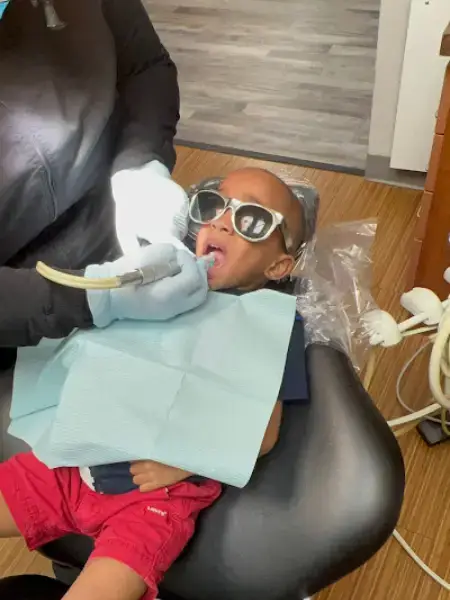
It is one of the easiest things we do for kids. There are no shots and no drilling.
- We clean and dry the chewing surface of each tooth.
- A mild gel is placed on the surface for a short time to help the sealant stick, then rinsed off.
- The tooth is dried again and kept dry with cotton or a small isolation tool.
- The sealant is painted into the grooves.
- A blue curing light hardens it in seconds.
- We check the bite and make sure the sealant is smooth.
Each tooth takes only a few minutes, and sealants can often be placed at the same visit as a cleaning and exam. Your child can eat and drink normally right after.
Which kids are good candidates?
Sealants go on healthy teeth. They are a prevention tool, not a treatment for a cavity that is already there. Good candidates include children and teens who:
- Have new permanent molars with no decay
- Have had cavities in baby teeth
- Have deep grooves on their back teeth
- Wear orthodontic appliances or have trouble brushing the back of the mouth
If we find a cavity, we will explain what we see and can usually treat it right here with a tooth-colored filling. We use local anesthetic only, so if a child needs sedation for treatment, we refer you to a pediatric dentist we trust.
How long do sealants last?
Sealants are durable but not permanent. Chewing slowly wears them down, and a piece can chip off. Many last several years. At each checkup we look at them and can touch up or replace worn areas.
Sealants only protect the chewing surfaces. Cavities can still form between teeth and along the gumline, so they work best alongside:
- Brushing twice a day with fluoride toothpaste
- Flossing once a day once teeth touch
- Professional fluoride treatments at checkups
- Cutting back on sticky snacks and sugary drinks between meals
You can read more about protecting young teeth on our dental sealants page and our preventive dentistry page.
Are sealants safe?
Yes. Sealants have been used for decades and are recommended by the American Dental Association and the CDC. Some parents ask about BPA. The amount of BPA exposure from a sealant is extremely small, far less than what people get from everyday sources like food packaging and receipts.
Does insurance cover sealants?
Many dental plans include sealants for children as a preventive benefit, but age limits and which teeth are covered vary by plan. We accept most PPO plans and children’s Texas Medicaid and CHIP plans from DentaQuest, MCNA and UnitedHealthcare (UHC) Dental, and we verify your coverage before the visit. If you are paying on your own, we give you a written estimate first. See our insurance page for details.
When to call us
Call us if your child’s 6-year or 12-year molars have come in and have not been checked for sealants, if a sealant feels rough or looks chipped, or if your child has a toothache, a dark spot or a hole in a back tooth. Call (832) 612-2831 — we’re open Tuesday, Wednesday and Saturday, 9am–3pm. Saturday visits make it easier to avoid missing school, or you can book online.
Frequently asked questions
No. There is no drilling and no numbing. Most children only notice the taste of the gel and the feeling of keeping their mouth open for a few minutes.
Sealants are meant for healthy teeth. A very early weak spot in the enamel can sometimes be sealed, but an actual cavity needs a filling first, which we can usually do for children right here in our office.
They may notice a slightly smooth or different feel for a day or two. If the bite feels high or uneven after that, let us know and we will check it.
No. Sealants protect only the chewing surfaces. Brushing with fluoride toothpaste and flossing are still needed to protect the sides of the teeth and the gums.
Sources
This guide is general information, not a diagnosis. Every mouth is different — the right treatment for you depends on an exam.